
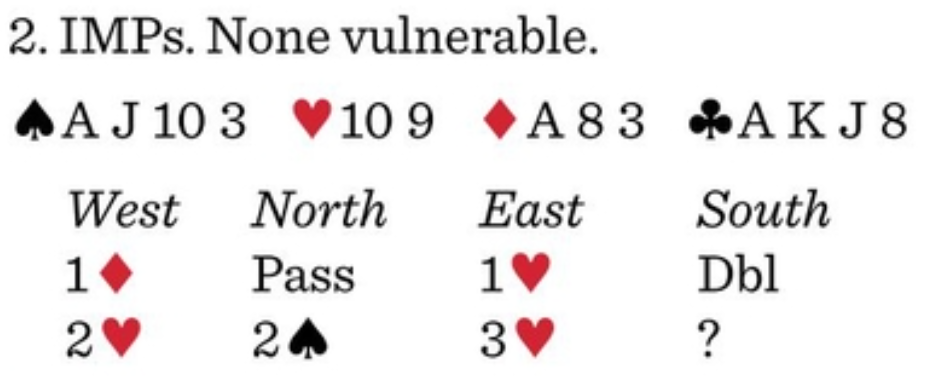
What’s your call?
| 3♠ | 3NT | |||
| 4♣ | 4♦ | 4♥ | 4♠ | 4NT |
| 5♣ | 5♦ | 5♥ | 5♠ | 5NT |
| 6♣ | 6♦ | 6♥ | 6♠ | 6NT |
| 7♣ | 7♦ | 7♥ | 7♠ | 7NT |
| Pass | Dbl |
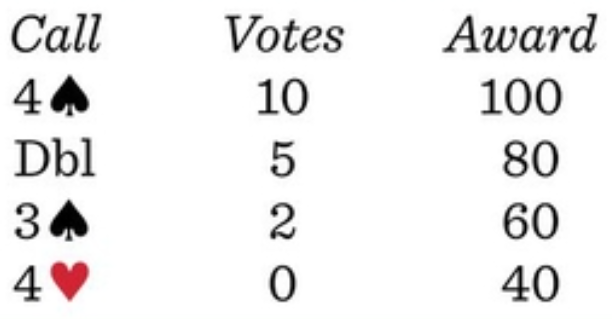
Stack says he must bid 4♠ because with as little as the ♠K and the ♣Q in partner’s hand, game is a virtual lock. “Passing 2♠ or raising to 3♠ has no appeal with this moose of a hand.”
New Hall of Famer Peggy Sutherlin is in there with 4♠ as well. She and John note: “Partner has at least 6 points to bid 2♠. That means we will have a good play for 4♠.”
4♠, says Lee, “seems right on values.”
“I can’t imagine not bidding game,” says Weinstein. “Even if I had the agreement that double showed an invitational hand with four spades (I think it should be extras with only three spades), I would still bid game with all these controls.”
Boehm agrees that the hand “is too rich in good cards to hang in 3♠.”
Korbel calls 4♠ aggressive. Still, it’s the call he makes. “It almost has to have play. Because it sounds competitive and not invitational, 3♠ would put too much pressure on partner.”
4♠ by Hampson. “This may teach partner a lesson for bidding on air, but double isn’t enough.”
Lawrence says, “Good values plus good spades plus sane shape add up to 4♠. It’s almost impossible that partner will bid 4♠ if I bid three. I think that double here would show a good hand with three spades, so partner won’t know to make the right decision.”
Colchamiro agrees that the odds greatly favor 4♠. “Is
♠K x x x x ♥x x ♦ x x x x ♣Q x
too much to hope for from partner? Will he really bid 4♠ if I make a game-try double?”
Meckstroth, on the other hand, employs a maximal double – “game try in spades.”
Rigal elaborates: “Extras – a game try – a maximum double, in other words. I would be delighted if partner chose to pass it out holding something like:
♠x x x x ♥A x ♦ Q x ♣x x x x x.
Falk’s a doubler. “Normally this shows only three spades, but I did make a takeout double for the black suits. I think this is a game try, leaving 3♠ to be competitive. I’d bid 3♠ without the ♦ A, so double it is.”
Robinson, too, elects to double. “Partner made a free bid, so I’ll play him for enough to make game. I’ll make a game-try double just in case he wants to penalize them. Over 3♠, I’ll bid 4♠. Because the 2♥ call in this auction didn’t necessarily promise four hearts, West might have raised on three and they could be hurting.” [Ed.: It wasn’t specified whether East–West are playing support doubles.]
Sanborn, too. “Last chance to make a game try. I have all the requirements, and I will be delighted if partner converts.”
Meyers shows extras with 3♠. “Partner could have ♠K Q x x and out. I don’t want to jam this into game.”
Cohen agrees 3♠ feels just about right. “I prefer this way to show extras as opposed to doubling again (which I might do with only three spades). I don’t want to bury partner in case he has something like ♠K Q x x x and out. If he has another useful card, he can raise to four.”
