
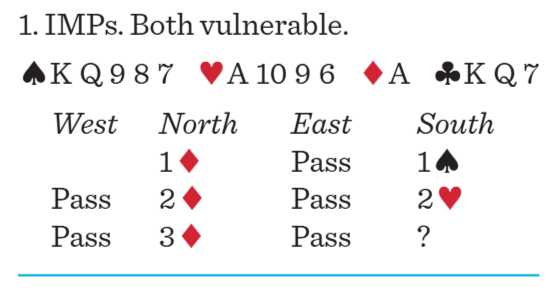
What’s your call?
| 3♥ | 3♠ | 3NT | ||
| 4♣ | 4♦ | 4♥ | 4♠ | 4NT |
| 5♣ | 5♦ | 5♥ | 5♠ | 5NT |
| 6♣ | 6♦ | 6♥ | 6♠ | 6NT |
| 7♣ | 7♦ | 7♥ | 7♠ | 7NT |
| Pass |
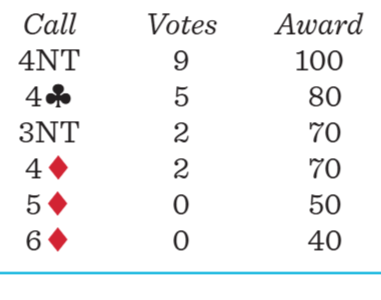
It’s interesting how many different meanings there can be for a single bid. Most of the panelists were drawn to 4NT and 4♣, but not for the same reasons.
Meckstroth’s 4NT: “I hope it is quantitative.”
Cohen: “4NT. I mean it as quantitative – since most experts would use 4♥ or 4♦ to ask for aces. But, if I hear what sounds like an answer to Blackwood, I’ll cope.”
Weinstein says his 4NT is quantitative because 4♣ would be a cuebid and 4♦ would be a raise. “If partner takes it as Blackwood, he had better have the decency not to have two key cards without the queen.”
Rigal agrees: “This should be natural and quantitative. Slam could be cold, or 4NT could be struggling, but I can hardly do less.”
Stack’s take: “This hand is too big to simply bid 3NT, so jumping to 4NT conveys extra values without the onus of being 100 percent forcing.”
Benedict’s 4NT asks for key cards. “Although unlikely, we could be off two key cards in diamonds. The big question is whether to play 6♦ or 6NT.” Pavlicek: “4NT. I won’t give up when partner’s ♦K Q-seventh and an ace offers a good slam (albeit possibly scuttled by a heart lead), and I see no way to find out what I need to know. At least this avoids reaching 6♦ off two key cards.” Falk’s 4NT means… well, whatever. “I’m not sure if this is Roman key card Blackwood for diamonds or just invitational; either way I should be OK. If I could be sure 4♦ is forcing, I would bid that.” Korbel’s 4NT: “I hope this is interpreted as quantitative, but if it’s taken as Blackwood, we may survive. Perhaps this is an overbid anyway.” Sanborn opts for 4♣. “Although I usually play 4NT here as quantitative, this time I can’t set or deny a trump suit first, so it should be key card in diamonds. It is easy to picture partner with an ace and ♦K Q J x x x x, but I can’t make the final decision with a singleton trump.” Lee likes 4♣. “I will cuebid for diamonds and see what develops. I don’t have enough to drive to slam, but more than enough to give it a shot.” Meyers is a 4♣ er, too. “I’m not sure how high I want to play this, but it seems like the strain will be diamonds. I think partner has seven diamonds. If partner jumps to 5♦ over 4♣, I will raise. And if partner bids 4♦ over 4♣, I will probably just raise to 5♦. I also considered bidding 4NT invitational over 3♦, but I don’t think I want to be playing notrump on this hand.” 4♣ by the Sutherlins caters to the full range of partner’s possible hands. “North may not have any more than a minimum 12-count with only two controls. But he may have values with slam in the picture.”
Boehm: “4♣. 4NT should be natural – this sort of hand but slightly weaker. I use 4♣ – a fourth-suit extension – to show strength and imply a diamond fit, preparing for control bids and RKCB. 4♦ wouldn’t necessarily be forcing.”
Hampson exercises restraint with 3NT. “We have more, but I think this is going to be the best spot facing most of partner’s hands.”
Colchamiro also likes 3NT. “With my singleton and partner’s monotonous bidding, I’m going low.”
Lawrence and Robinson both bid 4♦, but for different reasons.
Lawrence’s 4♦ is minorwood and asks for key cards in diamonds. “I think the greater problem may be how to reach 7♦.”
Robinson’s 4♦ raise turns the reins over to partner. “Maybe partner can bid RKCB.”
