
Play of the Hand Tips
A key trick-one play
It’s often said that many contracts go down at trick one. A careless play can mean all the difference in this deal from Bridge Master, a free, interactive declarer-play program on Bridge Base Online, emphasizes the importance of making a plan at trick one:
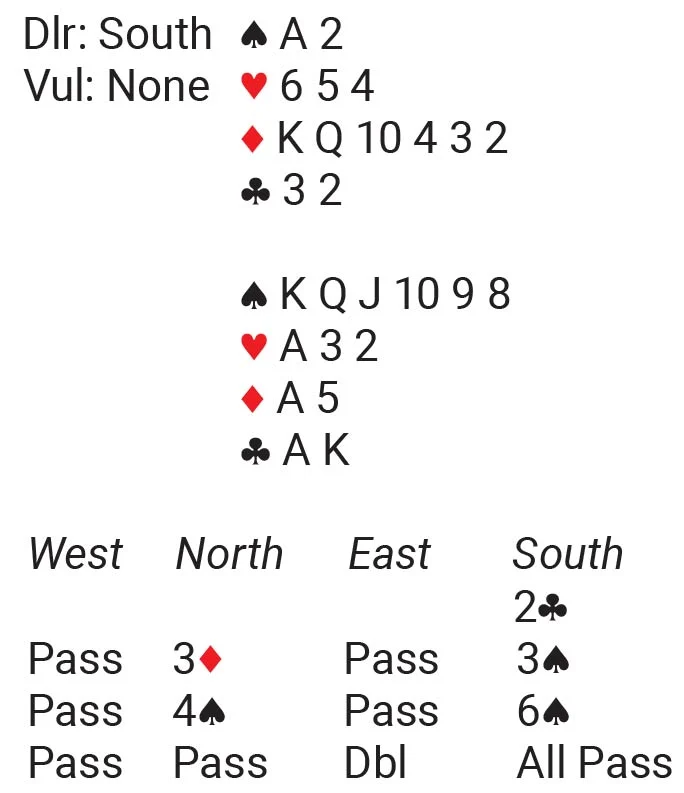
The bidding:
South opens a strong 2♣. North responds with a natural, positive 3♦, showing a long suit with two of the top three honors. South bids 3♠ and North, having already described their hand, bids 4♠, confirming a fit. South raises to slam and East doubles.
A double of a freely bid slam – called a “Lightner double” – asks for an unusual lead (or dummy’s first bid suit).
West obediently leads the ♦6.
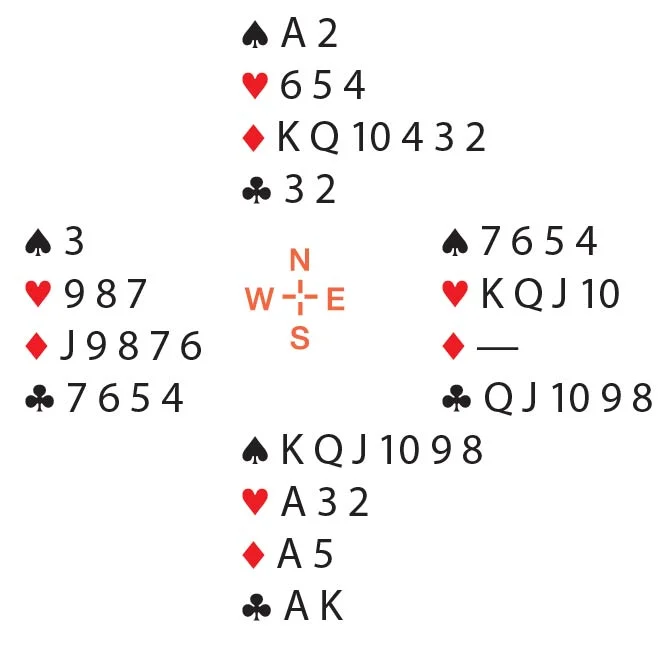
You have 12 top tricks, but it looks like this diamond is going to be ruffed. Sure enough, you play low, and East plays the ♠4. What do you play?
You must play the ♦A – unblocking – so that you can win any return, pull trumps and take the marked diamond finesse (♦5 to dummy’s 10) and discard two hearts on the ♦K Q.
Should you fail to unblock, you have no entry to dummy for the good diamonds.
Best Bidding
Taking Out Partner’s Double – continued
All-star teacher and Bridge Bulletin columnist Larry Cohen spent 2022 and 2023 covering takeout and negative doubles. In case you missed it, all columns are available online via the MyACBL portal. (Instructions at the end of the column.)
So far, we’ve reviewed Larry’s columns on the basic takeout double, which promises 12–17 high-card points (HCP) and support for the unbid suits, and the “big double,” a hand with 18+ HCP. We differentiated between direct-seat doubles (the opponent on your right opened the bidding) and balancing-seat doubles (your left-hand opponent opened, followed by two passes), and situations where the opponents have bid two suits and bid and raised one suit.
Next, we covered what to do as advancer when your partner makes a direct-seat takeout double. (Hint: take it out!) We discussed taking the double out to an unbid suit and how advancer (the partner of the doubler) could have 0 HCP – they are being forced to bid if their RHO passes.
Last month, we examined the remaining possibility for taking out a takeout double: notrump. We discussed that you must take out the double – even with 0 points.
But, that all changes if your RHO does something other than pass. You are “off the hook.” Consider the difference between these two auctions:
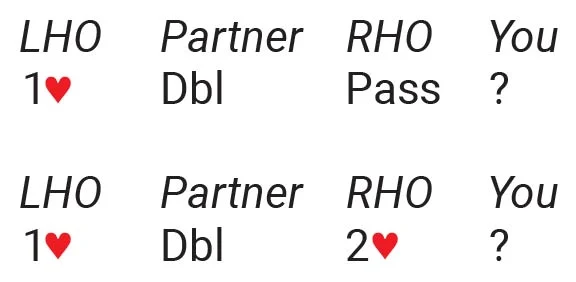
In the first auction, you can’t pass; so, you’d take out the double to your longest suit or notrump with a stopper and enough points. But, on the second auction, you don’t have to bid. They are in 2♥ (not doubled). You can comfortably pass if your hand is poor.
What if you do volunteer a bid after partner doubles and RHO acts? You surely wouldn’t bid with 0 HCP (nor 1 or 2). Not even 3 or 4 (unless you had exceptional shape). So, we define a “free bid” (meaning you bid freely, because you could have passed) as 5–8 HCP. You still jump with 9 or more. So, here is the schedule of meanings with examples:
- Pass = says nothing – could be zero points – just a hand that has nothing to say
- Suit bid (non-jump) = Natural (four or more cards) 5–8 total points
- Jump-bid = As defined in previous months
- Notrump = As defined in previous months – with their suit(s) stopped
So, after 1♦–Dbl–1♠, pass with:
♠J 5 4 2 ♥Q 7 6 5 ♦4 3 2 ♣9 2.
Bid 2♥ (a free bid, but not a jump) with:
♠9 7 ♥A Q J 5 ♦10 7 4 3 2 ♣8 3.
Jump to 3♥ (showing 9–12) with:
♠9 5 4 ♥A Q J 9 8 ♦J 3 ♣K 3 2.
Bid 1NT (6–10, stoppers) with:
♠K 2 ♥7 6 5 ♦A J 9 8 ♣7 6 5 2.
The main new thing to learn is that after RHO’s bid, you can pass with nothing, so bidding promises at least 5 points. You also have another call available – namely a double.
After 1♥–Dbl–2♥, what would it mean if you doubled? It isn’t likely you’d have a lot of hearts and want to double for penalty, so a double just shows some points but nothing clear to bid (it is technically called a “responsive double”). For example, after 1♥–Dbl–2♥, you could double with:
♠K 3 2 ♥3 2 ♦A 7 6 5 ♣J 8 7 6,
to say, “Partner, I’ve got some values and want to compete for the contract, but you choose the suit.” A responsive double shows about 7 or more points; the higher the level, the more that is required.
What if your RHO’s call isn’t a raise? For example, 1♥–Dbl–1♠? Now, what does a double mean? I confess – I’d rather not go there. Some partnerships still play it as responsive (“partner – do something”), but others play it as penalty for spades. What should you do? I suggest not making such a call unless you have a regular partnership and have agreed on one of the two (diametrically opposite) ways.
Also, your RHO might redouble (1♥–Dbl–Redbl). The redouble shows 10 or more points. Your side could be in trouble, so you no longer are promising values if you bid freely. You can pass with nothing special to say such as:
♠x x x ♥J x x ♦x x x ♣x x x x.
You can “run” without promising values. For example, after 1♥–Dbl–Redbl, escape to 1♠ with:
♠10 x x x x ♥x x x x ♦x x ♣x x.
If you pass, partner might pick a minor when it comes back to him.
The ACBL website offers a treasure trove of resources. Some are kept in a members-only section of the website called MyACBL. It’s via this portal where you can find the online Bridge Bulletin, with all issues going back to 2005 available. There is also a lot of personalized data.
To view any of these items, you must be logged in. Start by going to acbl.org and look for the MyACBL Login button at the top of the page. Click to log in. You will be taken to the login screen.
If you have already set up your MyACBL account, simply type in your member number and password in the appropriate fields and click the blue “Log In” button. If you do not yet have a MyACBL account, you can set it up by clicking “Register for MyACBL.”
You can also reset a forgotten password from this screen by clicking “Forgot Password.”
