
Play of the Hand Tips
Looking ahead
This deal from Bridge Master, a free, interactive declarer-play program on Bridge Base Online, mphasizes the importance of making a plan at trick one:
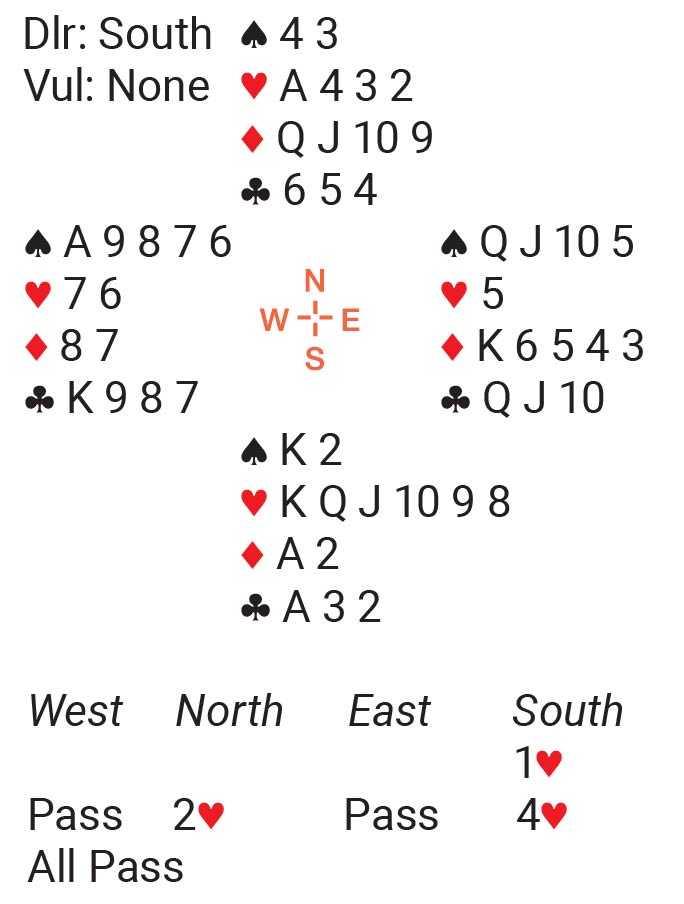
South, with extra values and a sixth trump, bids game after North’s single raise. The lead is the ♦8, covered with the queen. East plays the 3. As South, what’s your plan?
You potentially have two spade losers and two club losers. Because there is only one entry to dummy – the ♥A – it’s important to not let the ♦Q hold the trick! Plan the play as follows:
Win the ♦A at trick one, pull trump in hand (very important to preserve the ♥A in dummy), and then play the ♦2, knocking out the king. Now you have promoted two winners, the ♦J 10, in dummy.
The defense can take their two spades, but you can get to dummy with the ♥A to discard two clubs on the ♦J 10.
If the defense plays a club, win with your ace, go to dummy with the ♥A, and discard either two clubs or two spades on the ♦J 10.
Best Bidding
Taking Out Partner’s Double – continued
All-star teacher and Bridge Bulletin columnist Larry Cohen spent 2022 and 2023 covering takeout and negative doubles. In case you missed it, all columns are available online via the MyACBL portal. (Instructions at the end of the column.)
So far, we’ve reviewed Larry’s columns on the basic takeout double, which promises 12–17 high-card points (HCP) and support for the unbid suits, and the “big double,” a hand with 18+ HCP. We differentiated between direct seat and balancing seat doubles and situations where the opponents have bid two suits and bid and raised one suit.
Last month, we covered what to do as advancer when your partner makes a direct-seat takeout double (hint: take it out!). We discussed taking the double out to an unbid suit and how advancer (the partner of the doubler) could have 0 HCP – they are being forced to bid if their RHO passes.
In the July 2022 Bulletin, Larry examined the remaining possibility for taking out a takeout double: notrump.
Whereas taking out to a suit could be zero points, we certainly don’t want to take out to notrump with zero! Partner could have some shapely 11-count and there we would be in 1NT (likely doubled), severely outgunned. Because a takeout double can be light on high-card points, we want to have our fair share to dare to bid notrump (which is not usually what the takeout doubler had in mind). What are the ranges for taking out to 1NT, 2NT and 3NT?
I like to define the numbers as something players are already familiar with. I suggest that 1NT is 6–10, 2NT is 11–12 and 3NT is 13–15. Of course, a stopper in the opponent’s suit is required. Also, a notrump bid shows a balanced hand, unlikely to have four cards in the other major(s). Let’s look at some examples:

♠J 4 3 ♥10 7 ♦K J 9 8 ♣A 4 3 2
Take out the double to 1NT, showing 6–10 balanced with diamonds stopped is much more descriptive than bidding any number of clubs. Passing for penalty could work, but more defensive tricks would be desirable.
♠Q 10 2 ♥K J 2 ♦A Q 7 6 ♣10 8 7
Take out the double to 2NT. Show 11–12 balanced and invite partner to go to 3NT with some extras like:
♠A K J 5 ♥A Q 7 6 ♦4 ♣J 5 4 2.
With:
♠8 6 5 ♥Q 2 ♦K Q 10 ♣A Q J 7 6,
take out the double to 3NT. Show 13–15 (it could be a little more), balanced and a desire to play 3NT (more practical than trying for a club contract here).
♠A 10 7 6 ♥4 3 ♦Q 10 2 ♣6 5 4 3
Take out the double to 1♠. True, you have diamonds stopped and 6–10 HCP, but facing a takeout double, trying to play in a suit (especially a major) is recommended. Picture partner with a typical:
♠9 8 5 2 ♥A K 7 6 ♦5 ♣A 10 8 2,
and appreciate how superior spades is to notrump.
This concludes Deal Me In’s look-back to Larry Cohen’s series on doubles, which are available to read online. Here is a handy chart summarizing how to respond to partner’s takeout double.
| Action after partner’s direct seat takeout double | Meaning |
|---|---|
| Pass | Usually a mistake; should be at least five good trumps in their suit and a desire to defend. |
| Non-jump in a suit | 0–8 and four or more cards (rarely three if stuck). |
| Single jump in a suit | 9–12 and four or more cards. |
| Double-jump in a suit | Highly invitational (example: 1♦–Dbl–Pass–3♥). This is somewhat superfluous and rarely used (some even define it as weak with a long suit). |
| Jump to game | Good hand (roughly opening bid strength). Usually five or more cards and a belief that this is the correct contract. |
| Cuebid | Strong hand, unsure where to play. More on this down the road. |
| 1NT | 6–10 balanced with their suit stopped (usually denies four cards in an unbid major). |
| 2NT | 11–12 balanced with their suit stopped (usually denies four cards in an unbid major). |
| 3NT | 13–15 balanced with their suit stopped (usually denies four cards in an unbid major). |
Some key takeaways:
- Level: Don’t be in a hurry to jump from 1♠–Dbl–Pass to 3♣ with a lousy 9-count such as: ♠7 6 5 4 ♥Q 2 ♦Q J 2 ♣K J 3 2.
- Shape: Upgrade for five-card or longer suits and shortness when your side likely has a fit.
- Spot cards: 10s, 9s and even 8s are important. Upgrade for holdings such as A–J–10–9 or 10–9–8–7.
- Quality of honors: Upgrade for aces and kings. Downgrade for queens and jacks in the opponent’s suits.
The ACBL website offers a treasure trove of resources. Some are kept in a members-only section of the website called MyACBL. It’s via this portal where you can find the online Bridge Bulletin, with all issues going back to 2005 available. There is also a lot of personalized data.
To view any of these items, you must be logged in. Start by going to acbl.org and look for the MyACBL Login button at the top of the page. Click to log in. You will be taken to the login screen.
If you have already set up your MyACBL account, simply type in your member number and password in the appropriate fields and click the blue “Log In” button. If you do not yet have a MyACBL account, you can set it up by clicking “Register for MyACBL.”
You can also reset a forgotten password from this screen by clicking “Forgot Password.”
