
What’s your call?
| 2♥ | 2♠ | 2NT | ||
| 3♣ | 3♦ | 3♥ | 3♠ | 3NT |
| 4♣ | 4♦ | 4♥ | 4♠ | 4NT |
| 5♣ | 5♦ | 5♥ | 5♠ | 5NT |
| 6♣ | 6♦ | 6♥ | 6♠ | 6NT |
| 7♣ | 7♦ | 7♥ | 7♠ | 7NT |
| Pass | Dbl |
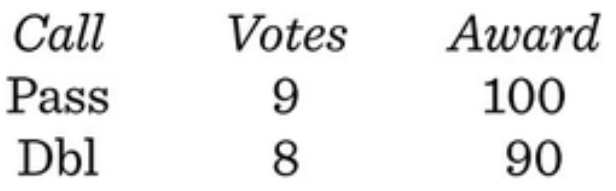
Another fairly evenly divided panel, except this time, it seems everyone’s saying the same thing, just oppositely.
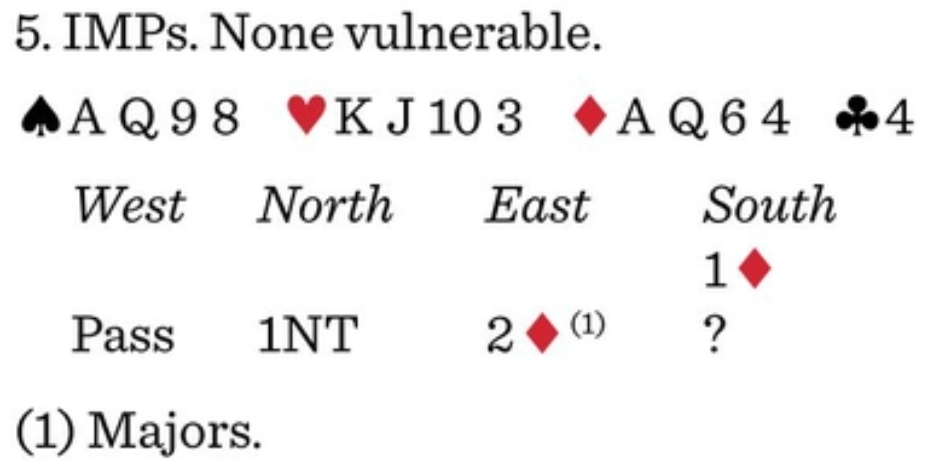
“Odd position,” says Lawrence as he passes. “Will partner be more likely to bid 3♦ if I double or if I pass? I want a chance to double two of a major, and I hope that passing here will improve my chances. Also, if I pass, West will be the one to bid that major. I don’t want to double 2♦ and have East bid a major. That would leave me on lead.”
Using the same rationale, Korbel passes. “I hope that by passing and then doubling, partner will work out that it should be penalty. Hopefully he does not trip me up by bidding clubs first. Doubling here would show longer diamonds and invite partner to compete.”
Hampson, too: “I don’t want partner to feel tempted to raise diamonds, so I will pass, then double.”
Stack passes. “A double in this position should show length in diamonds and willingness to compete there. It should not show that we are loaded in the majors and wish to punish them. We will pass for now and double their major to try to show this type of hand.”
Lee sees no good alternative to passing. Meyers and Meckstroth are also of the “pass first, double subsequently” persuasion.
Weinstein passes. “I want to defend two of a major, and I think pass then double is penalty. Some would take a double of 2♦ as looking to penalize. I would take it as a hand on which I wanted to bid 2♦ .”
The Sutherlins: “Double, double, the opponents are in trouble!” (OK, so the meter’s a little off.) “Our double of 2♦ says we have extras and interest in defending two of a major. We will be able to make a penalty double of East’s major-suit bid.”
Sanborn doubles. “Double then double should be penalty. Pass then double is more optional.”
Rigal doubles. “Pass and then double sounds like takeout, and not this hand. But if my partner told me that my double was clearly long diamonds, I might not be able to argue with him. Who am I kidding? I can argue with anyone.”
“Double,” thunders Boehm. “Don’t let them off the hook.”
Robinson’s double translates: “Either I want to punish them or it shows long diamonds. I hope partner will let me show which I have.”
Double by Colchamiro, “for a hundred obvious reasons.”
Double by Cohen. “Whatever it means.”
And on that note, we’re done for the month. You can open your eyes now, Jill.
