
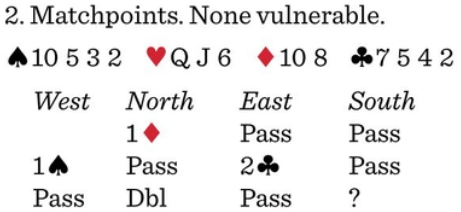
What’s your call?
| 2♦ | 2♥ | 2♠ | 2NT | |
| 3♣ | 3♦ | 3♥ | 3♠ | 3NT |
| 4♣ | 4♦ | 4♥ | 4♠ | 4NT |
| 5♣ | 5♦ | 5♥ | 5♠ | 5NT |
| 6♣ | 6♦ | 6♥ | 6♠ | 6NT |
| 7♣ | 7♦ | 7♥ | 7♠ | 7NT |
| Pass |
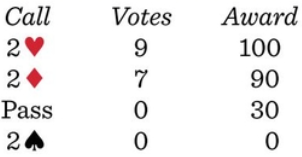
Robinson calls 2♥ the lesser of two evils. “Partner could be 4=4=4=1, so I don’t want to bid 2♦ and play in a 4–2 fit.”
Lawrence bids 2♥. “I expect partner’s double was takeout. He might have doubled 1♠ for takeout. Doubling 2♣ for penalty doesn’t feel likely. He probably has four hearts and five diamonds and three or four spades. I don’t expect this to be a triumph.”
Meyers says, “It might be right to bid 2♦ , but I want a heart lead if they compete. And because it is matchpoints, I’ll try the seven-card major-suit fit.”
Ditto Sanborn: “Partner has a good hand short in clubs. The obvious question is the rest of the shape. I’m thinking that with 4–5 in the reds, he might have doubled the previous round, correcting clubs to diamonds. But with 4=4=4=1, that option wasn’t on the table. I am aware that our longest fit could well be spades, but that might not play too well.”
Even “knowing” partner has four spades doesn’t make 2♠ the best choice, as it is more likely to be doubled if it is wrong.
Stack eyes the 2♠ possibility, but selects 2♥ as his call. “It is tempting to bid spades since partner is sure to have three, if not four, of them.”
Colchamiro, who mercifully has collected his wits, bids 2♥. “Partner obviously has spades and is probably 4=4=4=1 or 3=4=5=1. With as many as two clubs, he would have opened 1NT (15–17) or bid 1NT over 1♠ (18–19). So partner has some extras, but needs a stiff club to justify coming in opposite my 0–5 point hand.”
2♥ is Boehm’s call. “North should have 4–5 in the reds and strength between a minimum and a reverse. We may scramble home ruffing diamonds with high trumps.”
Korbel likes 2♥. “Yes, I know partner has spade length for this sequence – often 4=4=4=1. I’m not willing to bet on it, or bet that 2♠ will necessarily play better than 2♥. This could be a 3–3 fit.”
Weinstein: “2♥. I would need better clubs to pass.”
Meckstroth calls his 2♦ an ugly choice. “Perhaps I should bid 2♥ with three of them.”
Hampson chooses 2♦ . “I have no tricks, so I can’t possibly pass a takeout double. I hope partner has a fifth diamond.”
Lee: “2♦ . Looks like playing the (hopefully) 5–2 fit is as good as anything.”
Cohen goes with 2♦ . “Partner’s most likely shape is 3=4=5=1. I am just trying to survive with a number under 100 one way or the other. Pass brings minus 180 into play. Bids higher than 2♦ bring more than minus 100 into play.”
Rigal ponders the possible patterns. “Partner rates to have a 3=4=5=1 with extras – maybe 16-plus, but not a full reverse, or he might have doubled 1♠ planning to correct 2♣ to 2♦ or 2♥; he might also have bid 1NT over 1♠ with the right 2=4=5=2. Dummy will be 5=3=3=2, declarer 1=3=3=6 maybe – but either red suit could be 4–2, of course. Knowing the shapes doesn’t really help. I envisage that we won’t get more than plus 100 here if I pass, and 2♦ might play for 90 or 110 if all the cards are onside.”
The Sutherlins offer another possible pattern: 3=3=6=1. “Let’s start wriggling out with 2♦ .”
2♦ by Falk. “I expect North has some 3=4=5=1 hand, and while 2♦ has no bells on it, 2♣ is going to make with overtricks, so I’m going to hope 2♦ is our smallest minus.”
