
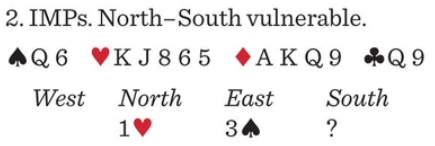
What’s your call?
| 3NT | ||||
| 4♣ | 4♦ | 4♥ | 4♠ | 4NT |
| 5♣ | 5♦ | 5♥ | 5♠ | 5NT |
| 6♣ | 6♦ | 6♥ | 6♠ | 6NT |
| 7♣ | 7♦ | 7♥ | 7♠ | 7NT |
| Pass | Dbl |

4♥ by Meckstroth, who notes the similarities between this hand and the previous one. “Could be cold for slam.”
Stack thinks that 4♥ is about all this hand is worth. “It would be nice if 4♦ would show a slam try for hearts with diamond values, but alas, that is not what it shows. We will be content with the simple raise to game.”
Colchamiro: “My vote is for a quiet 4♥. The ♠Q and ♥J are red herrings, so we’re down to 14 working points, not enough to risk the five level.”
4♥ by the melodramatic Korbel, who groans, “An impossible problem. If we bid 4♥, we could miss a cold slam, but if we bid 4♠, we could get too high. Even 5♥ is too high opposite:
♠K x x ♥Q 10 x x x ♦ J x ♣A K x.
I will take the low road and bid 4♥. A treatment that I like that solves this type of problem is to use 4♣ as a raise of partner’s suit whenever the auction gets cramped. So here, 4♣ would set hearts as trumps, and 4♠ would show a good hand with clubs. Sure, this makes auctions harder when you have clubs, but it makes these more common auctions enormously easier.”
Cohen, another 4♥er, tells of a similar treatment. “Marty Bergen would love this problem. He (correctly) thinks there is no need for a natural four-of-a-minor bid here, so he uses 4♣ and 4♦ as various strengths of heart raises. The only problem is that both partners have to remember it is available. As to why I take the low road, picture this as partner’s hand:
♠J x ♥A Q 10 x x ♦ x x ♣A 10 x x.”
Robinson’s 4♥: “This is why you should play 4♣ as an artificial, good heart raise. Because I don’t have that available, I’ll go low.”
Lee leads off the 5♥ road crew working on High Street. “It could end up badly, but I think we are reasonable favorites to make slam opposite a spade control, so I will go high.”
Rigal reiterates using 4♣ as a heart raise here, but he’s not about to smack his partner with a treatment that isn’t on the convention card. “So I repeat the successful call from the previous deal – a jump to 5♥ – but this time it asks for a spade control. Does that mean slam will make if partner moves on with a ‘good’ hand such as:
♠K x ♥A Q x x x ♦ x x ♣A J x x?
Obviously no. But we have to try, don’t we?”
Sanborn: “I think 5♥ has to be quantitative with no spade control. It comes closest to describing what I have.”
Meyers is back with another 5♥ call. “This 5♥ (as opposed to problem No. 1) asks partner to bid a slam with a control in the opponents’ suit. This hand qualifies, in my opinion.”
Weinstein, too, is two for two bidding 5♥. “Too much to just settle for game. This shouldn’t demand that partner bid a slam with a spade control; it’s a slam try without a spade control.”
Lawrence: “5♥. Who knows? Are you trying to annoy your panel this month? [Always, Michael.] The problem with 4♥ is that you will still hear 4♠ nearly all the time. Bidding 5♥ now shows slam interest, something 4♥ does not. No bid comes with guarantees.”
Falk doesn’t like it, but he bids 4♠. “I’ve just got way too much for 4♥, and 4♦ does not solve my problem – I won’t be showing such massive heart support when I bid 5♥ on the next round. If we go down in 5♥, unlucky.”
Hampson cuebids 4♠ and then quickly jumps into the passenger’s seat. “I want to move toward slam in hearts without driving. Hopefully partner will have the necessary assets to use RKCB.”
