

What’s your call?
| 4♥ | 4♠ | 4NT | ||
| 5♣ | 5♦ | 5♥ | 5♠ | 5NT |
| 6♣ | 6♦ | 6♥ | 6♠ | 6NT |
| 7♣ | 7♦ | 7♥ | 7♠ | 7NT |
| Pass |
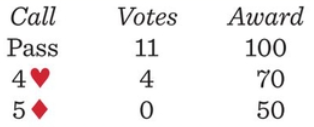
Cohen explains his pass and one tenet of BAM strategy: “No need to press to a close game at this form of scoring.”
Korbel elaborates. “While I would try either 4♥or 5♦ at IMPs – because the game bonus is so appealing – at BAM, it is very dangerous to bid here again. You need a perfect hand from partner to make either 4♥ or 5♦ , and besides, we don’t know which one to bid. It is surely less than 50% that partner will have the right hand for us to make game, so I feel comfortable passing. We are allowed to put down a good dummy once in a while.”
The Sutherlins choose pass from among their three “reasonable guess bids”: Pass, 4♥ and 5♦ . “Partner may have stretched to enter the auction, and he did not double for takeout. If he has something like: ♠A K x ♥x x ♦ A K J x x x ♣x x, then 4♦ is our best last-makeable spot.”
Pass by Hampson. “My hand may be worthless.”
Pass by Lawrence. “Where are the spades?”
Ditto the psychic Ms. Meyers: “I know my right-hand opponent does not have much length in diamonds, so I suspect he has length in the majors. I don’t think we are taking 11 tricks in diamonds, either.”
Colchamiro says he is going low with a pass for three reasons. “One, partner acted under pressure and may have been forced to stretch. Two, I have the death holding – two low clubs. It looks like we’d have to run the table in the other suits playing 5♦ . Three, East didn’t push forward at favorable vulnerability, which reinforces point two. Of course, I could be all wet.”
Lee passes. “Because partner would strain to double in this spot, 4♥ feels really speculative to me. I don’t like 5♦ , just not enough values.”
Stack calls it tempting to bid because of the four-card trump support, but he passes. “Holding no aces and only one king, there is a good chance that we are high enough. Why punish partner for bidding with a hand like:
♠K J x ♥x x ♦ K Q J 10 x x ♣A x?
I think everyone would bid with this hand, but on a club lead, we probably cannot make even 4♦ .”
Falk’s pass: “Partner is more likely than at IMPs or even matchpoints to have made a daring call already. What little I have is quite possibly of no use to partner, who might have doubled with a 3–3–6–1 pattern or 3–4–5–1 or 4–3–5–1. He is a huge favorite to have seven diamonds and could easily hold a very sound 4♦ bid – something like:
♠A J x ♥x ♦ A Q J x x x x ♣K x,
where we’d be lucky to make 4♦ after a club lead. At IMPs or matchpoints, I would have no reason to think we will take exactly 10 tricks in diamonds, and I would probably bid something, but at BAM, we might win the board with plus 130 or minus 100.”
Boehm is a 4♥ bidder. “I played in many tough BAM events in New York City over the years and won my share. The strategy that stood me in good stead was a conservative matchpoint style: avoiding heroics and trying not to lose a board irretrievably.”
Sanborn also prefers 4♥. “Could be the only maker.”
Rigal, 4♥: “I am not sure if this is sensible or not; either pass or 5♦ might work. Note that at this form of scoring, we only need to beat the other pair with our cards. If game is bad, pass might well hit the jackpot. Still, I’ll go for the max, expecting partner to bid 5♦ or 4♠ with a really unsuitable hand.”
Surprise! Robinson bids the major. “4♥. Partner doesn’t have to have just seven solid diamonds and out, and partner doesn’t have to pass 4♥ with heart shortness. At IMPs, I’d probably just raise to 5♦ .”
