
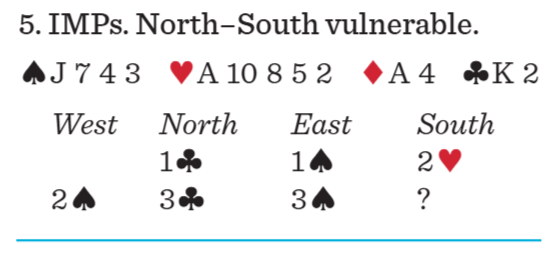
What’s your call?
| 3NT | ||||
| 4♣ | 4♦ | 4♥ | 4♠ | 4NT |
| 5♣ | 5♦ | 5♥ | 5♠ | 5NT |
| 6♣ | 6♦ | 6♥ | 6♠ | 6NT |
| 7♣ | 7♦ | 7♥ | 7♠ | 7NT |
| Pass | Dbl |
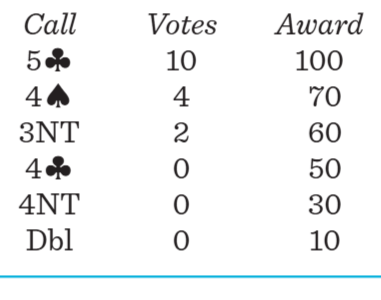
Lee calls 5♣ the practical value bid. “Partner can still bid slam with a truly amazing hand.”
Henneberger goes into a little more detail. “Doubling would be a kneejerk reaction and would often end the auction. Partner is at most 1–2 in the majors. I have important cover cards where partner needs them and no spade wastage. I would be more afraid of missing slam than overbidding, and feel the least I can do is bid 5♣.”
Donn bids 5♣, saying he isn’t clear what’s forcing at this point. “I will just make a value bid.”
Weinstein, likewise. “I would like to bid a forcing 4♣, but because I’m not sure that 4♣ is forcing, I’m going with 5♣. There are not enough hands where partner would bid only 3♣ where slam is probable enough to make it worth it to cuebid 4♠.”
Meyers likes 5♣ “because it’s what I think we can make.”
Meckstroth, too: “My values should be great for clubs. I’m a bit worried we may belong in slam.”
5♣ by Boehm. “Spades might block for 3NT, but 5♣ is safer and may lead to a good slam.”
Robinson bids 5♣ because he expects to make 5♣. “3NT needs partner to have solid clubs. 5♣ just needs partner to have something like: ♠x ♥K x ♦K Q x ♣Q J x x x x x.”
Korbel, 5♣: “Hmm… looks like partner is either 6–4 in the minors or has seven clubs. 5♣ is very good opposite as little as: ♠x ♥x x ♦K Q x x ♣A Q x x x x, and although 3NT is playable, too, I prefer the safety of the suit contract.”
Sanborn isn’t so sure about 3NT. “I can’t think of a hand that has no play for 5♣, but 3NT could be iffy.”
Holding controls and values in all the right places, four panelists wield a 4♠ cuebid.
One is Lawrence. “I could bid 4♣, but 4♠ should imply great interest in a club slam. Even more so than 4♣. Even 4NT is a possible choice. I note that if partner asks for key cards, I can show three and partner will know my exact hand. If I ask for key cards, partner’s answer won’t help me much.”
Another is Cohen: “4♠. A really big bid, because I can envision slam opposite nothing – like, ♠x ♥K x ♦K x x ♣A Q x x x x x.”
Shi cuebids. She and Larry should partner up – they have the same expectations of partner:
♠x ♥K x ♦K x x ♣A Q x x x x x.
“This is an easy slam. I can’t imagine partner accepting with less, holding only one key card, but if they do, the contract might hinge on a diamond finesse or a heart break,” Shi says.
Colchamiro chooses 4♠. “Partner can’t have many major-suit cards, so he has clubs and diamonds. Because everyone is bidding, partner figures to have more shape than high-card points. My hand is huge opposite:
♠x ♥x ♦K Q x x ♣A Q J x x x x.
Is that such an unrealistic construction?”
You knew there was going to be at least one – or in this case, two – 3NT bidder.
Hampson’s strategy: “I expect to be able to block the spade suit even if I don’t have a stopper, and then take lots of tricks once I have the lead. If partner has a void in spades or very weak clubs, then maybe they will come again over 3NT and we can get to 5♣ or 6♣.”
Rigal’s rationale for 3NT: “I expect partner to run with a void and for us to have nine tricks, even if a spade honor is tripleton to my left and partner sits for 3NT with a void. You could persuade me to defend here, but somehow I’m not expecting the auction to be over yet. Partner feels like 0–2–4–7 or the like and 5♣ will be just fine if he removes 3NT.”
