
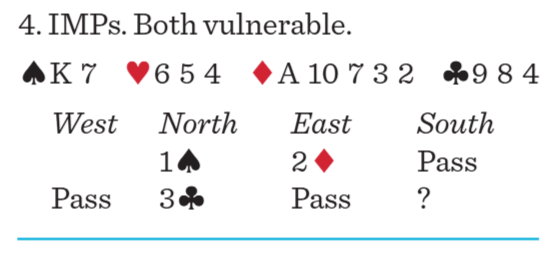
What’s your call?
| 3♦ | 3♥ | 3♠ | 3NT | |
| 4♣ | 4♦ | 4♥ | 4♠ | 4NT |
| 5♣ | 5♦ | 5♥ | 5♠ | 5NT |
| 6♣ | 6♦ | 6♥ | 6♠ | 6NT |
| 7♣ | 7♦ | 7♥ | 7♠ | 7NT |
| Pass |
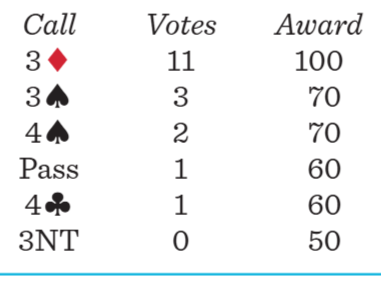
Today, the cuebid means “forward going” or “unsure of where we are going.”
Here’s how Hampson explains 3♦ in a sentence: “I have a useful hand for partner, so I will make a forward-going bid.”
Lawrence: “3♦ – I am not sure where we’re going. My hand is too good to pass or to bid 3♠. But not so good that I want to bid a game.”
The Sutherlins’ 3♦: “Partner should consider that we may be inviting game in spades rather than in notrump or clubs.”
Cohen offers a kind of waiting cuebid: “I don’t want to do anything final. Let’s see if partner repeats one of his black suits.”
Robinson’s 3♦ solicits more information. “Let partner tell me if he has rebiddable spades or rebiddable clubs.”
Weinstein’s 3♦: “An ace and a king is pretty good for somebody who hasn’t shown anything.”
Korbel says, “I could have a very good hand for partner. I will start with a cuebid to try and sort out whether we belong in clubs, spades or notrump.”
Boehm’s 3♦ is searching. “I hope partner’s next bid provides direction. At this stage, both level and strain are unclear.”
Colchamiro has all the continuations mapped out after his 3♦: “I’ll bid 3♠ over partner’s 3♥, raise 3♠ to 4♠, and pass 3NT. At matchpoints, I might take a more conservative approach, but vulnerable at IMPs, I’m all in.” 1. Matchpoints. North–South vul.
♠A 4♥3♦A Q J 2♣A 8 6 4 3 2
West North East South 1♣1♦2♦ (1) 2♥ Dbl Pass? (1) Limit raise in clubs or better. 2. Matchpoints. Both vulnerable.
♠J 6 5♥A K 9 5 4♦A 7 3 2♣5
West North East South 1♥
3♦4♣ Pass? 3. Matchpoints. North–South vul.
♠7 6 5 2♥A K J 8 7 6 4♦— ♣A 3
West North East South 1♥
Pass 1♠ Pass? 4. IMPs. None vulnerable.
♠A 8 6♥K ♦A K 8 5 3 2♣9 7 5
West North East South 1♣ Pass 1♦
1♥2♠4♥? 5. IMPs. North–South vulnerable.
♠Q 5 4♥A Q 10 5 4♦9 8 2♣7 5
West North East South 1♦ Pass 1♥
Pass 1♠ Pass? Lee’s 3♦: “I’m not inclined to play 3NT if partner bids it because one red suit or the other is likely to be a problem. I will try to offer spades next turn, and if game is too high, so be it.”
Sanborn shuns the cuebid because its traditional message isn’t the one she wants to send. She bids 3♠. “It would be convenient if 3♦ were some kind of invitation, but it classically means I was trap-passing and I have game values. I can’t know whether I have enough for game in spades, but I have too much to pass 3♣.”
Stack chooses 3♠. “We have two big cards for partner, and we will take our preference to 3♠ in perfect tempo if that is possible. Suits may not be breaking well, so being conservative and trying for a plus score will hopefully pay off.”
3♠ by Benedict. “If partner has a good hand, 10 tricks could be easier than 11. Passing 3♣ is too pessimistic.”
Falk and Meyers reach for the spade game.
Falk: “4♠. North is at least 5–5 in the blacks and probably has no diamonds. My ♦A is perhaps good for a discard but not much more. 4♠ ought to have some play. Because I am never going to bid 5♣, it’s better to blast to game and avoid a possible double. 3♦ seems pointless. For that, I should have the same hand with ♣Q at least.”
Meyers also leaps to 4♠. “Partner has a distributional hand. It may not be rich in high-card points, but we are vulnerable at IMPs and I am taking my chances.”
Meckstroth is the lone pass. “I might have the right stuff but there’s no safety in bidding.”
Pavlicek supports partner’s clubs. “4♣. Partner should be at least 5–5, and I certainly owe him a bid with two useful cards. A spade preference (3♠) shows nothing, and 4♠ precludes getting to clubs, while 4♣ does not preclude getting to 4♠. Cuebidding 3♦ solves nothing, as I wouldn’t like 3NT if partner bid it (heart lead), and I don’t want to force to game.”
