

What’s your call?
| 3♦ | 3♥ | 3♠ | 3NT | |
| 4♣ | 4♦ | 4♥ | 4♠ | 4NT |
| 5♣ | 5♦ | 5♥ | 5♠ | 5NT |
| 6♣ | 6♦ | 6♥ | 6♠ | 6NT |
| 7♣ | 7♦ | 7♥ | 7♠ | 7NT |
| Pass | Dbl |
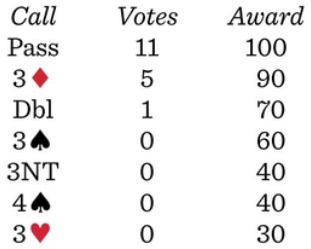
Problem No. 2 is a methods question rather than a true bidding problem. Expert panelists are loathe to get into methods discussions, asserting that it’s up to a partnership to figure these things out for themselves. For the benefit of partnerships who may not have nailed down how to handle this type of interference in their Jacoby 2NT auctions, however, they agreed to speak on the subject.
Lawrence says this hand shows how important it is for RHO to get in with a cheap bid. “It messes with their bidding. Rodwell once overcalled 3♠ holding ♠K 10 9 x on a 1♥–Jacoby 2NT auction. Don’t laugh. It helped us win the 1985 Vanderbilt final!”
Lawrence goes on to detail his methods. He passes, which denies a club control – ace or king. “If partner wishes to double 3♣, I can accept it. Double by me would say I have a balanced hand with the ♣A or ♣K. 3♦ shows a singleton and also a club control (ace or king). 3NT would show a club singleton. 4♣ shows a void in clubs and 4♠ shows a crappy hand.”
Cohen passes and elaborates. “Based on current expert practice (not that I’m a practicing expert): Over Jacoby 2NT interference, most experts play double as shortness in the opponent’s suit. New suits show a control and guarantee a control in the suit overcalled. Pass denies shortness, denies a flat minimum and, if responder now doubles, it is for penalty.”
Falk agrees. “I think pass denies a club control, which is important information for partner. If partner has a singleton club or another control, he will bid something other than 4♠, and then I can cooperate in a slam exploration.”
Pass by Hampson. “Although I have a strong playing hand, I need to tell partner that I have at least two club losers before we get too far in the bidding. This is what pass should convey.”
Sanborn, too. “I like to play that any action shows a control in the overcalled suit. If I pass and partner shows any interest, then I am off to the races.”
Weinstein passes primarily to leave open the possibility of defending 3♣ doubled if partner doubles. “Bidding should probably show a club control. And there’s nothing else I really want to bid. I’m not thrilled about showing shortness with a stiff ace that isn’t in the opponents’ suit.”
Meyers says that even if she didn’t play that pass here denies a club control, “I would probably still pass to see what partner does.”
Pass by the Sutherlins, very simply: “Let’s see what happens. If partner moves toward slam, we will cooperate.”
Boehm’s system says bid 3♦ . As does Meckstroth’s and Stack’s.
As does Kennedy’s: “It’s not good to have a singleton ace or king, but it’s what I would have bid had RHO passed.”
Colchamiro bids 3♦ , too: “I think 3♦ still shows a singleton. I, personally, don’t mind it with a singleton ace. My structure over Jacoby 2NT interference is: double = shortness in the overcalled suit; pass = shortness in suits below the overcall; suit bids above the overcall = shortness; three of our agreed major, 3NT and four of our major are as we have agreed.”
Rigal and his posse do things a little differently. He doubles. “We play double shows weak length (at best, Q–x–x) – a hand where game might not make facing a minimum hand that also has some club length. Here, if we end in 3♣ doubled when partner has an unremarkable
♠Q x x x ♥A J x ♦ K Q x ♣x x x,
we set them 800 against a non-makeable game … and that will teach them. For the record, pass forces double facing a ‘normal’ hand – either penalty or a hand about to make a slam try – and 3NT/four of their suit shows a singleton/void in their suit.”
