

What’s your call?
| 4NT | ||||
| 5♣ | 5♦ | 5♥ | 5♠ | 5NT |
| 6♣ | 6♦ | 6♥ | 6♠ | 6NT |
| 7♣ | 7♦ | 7♥ | 7♠ | 7NT |
| Pass | Dbl |
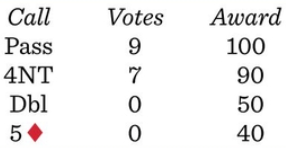
Do you wrest control of the auction or rest – forcefully – and let partner make the next move?
Robinson passes. “See what partner does. If partner bids 5♣, I’ll bid 5♥, which will be a cuebid.”
Meyers notes, “Pass is forcing. I want to see what partner bids before I commit. We could be cold for 7♦ on this hand.”
Pass by Sanborn: “For a minimum, I have an encouraging hand. All of my high cards are ‘wearing pants.’ I don’t want to discourage partner from bidding by doubling, yet I don’t want to overstate my values either.”
Kennedy says she passes. “Having already bid 2♦ with this flat hand, I have no extras. If partner cuebids 5♣, I’ll cuebid 5♥.”
Falk gets out of partner’s way with a pass. “North should have had some direction in mind when he bid 3♠. Thank goodness East took me off the hook, as I have no idea what I would have done directly over 3♠ (maybe 4♥). If partner has a singleton spade, or no spades, I’ll catch a further suit bid. If partner doubles, he was probably trying for 3NT with a doubleton spade and a very good hand, and I can take a fielder’s choice. With trump leads, I would expect them to go down four or five in 4♠ doubled – better than our score for 5♦ or 5♥.This should be unanimous – a true WTP.” (WTP is IYC panel-speak for “What’s the problem?” The editors take devilish delight in publishing these quips, but only when the vote is not unanimous!)
Colchamiro makes a forcing pass and has the postmortem fully scripted. “Over partner’s double or 5♦ , I’ll bid 5♥, and if he then gives me 6♣, that’s all I need to bid 7♦ . If over 5♥ partner bids 5♠, I’ll surely bid 7♦ and explain to him that his bidding was too aggressive holding:
♠— ♥Q J 10 x x ♦ A J x x x ♣K Q x.
And even if he does have that, we might survive if the opening leader doesn’t have the ♣A. This seems like the best approach because partner is likely to have two aces for his 3♠ call.”
Cohen passes. “My parents used to tell me, “If you don’t have anything intelligent to say, don’t say anything at all.”
Boehm passes. “Slam-bound. Partner seems short in spades with a diamond fit. Still, why not try for additional information? If partner cuebids 5♣, I can try 5♥, clearly a control bid because I could have bid 5♥ immediately with genuine support. A grand slam is certainly possible, with, for example:
♠A ♥Q J 10 x x ♦ A J x x ♣A x x.”
Weinstein, on the other hand, “wheels out trusty ol’ Black. I assume partner has short spades with diamond support. I hope he shows two key cards with a void so I can bid seven.”
So does Meckstroth. “4NT should be Roman Key Card Blackwood for diamonds.”
Korbel, too. “Pass may be the panel’s answer, but holding the ♥A K, I just want to take control of the auction, as it will be too hard for partner ever to envision a grand slam. 3♠ agreed diamonds, so 4NT is RKCB for diamonds. I am bidding 7♦ if partner shows three key cards or two key cards and a void.”
Lee thinks 3♠ shows shortness, and he has just one question. “4NT: How many aces, partner?”
Hampson feels secure in bidding RKCB for diamonds. “If partner has the spade void, I hope he shows it because a grand slam seems likely facing a void and the two missing key cards.”
Stack says. “4NT. There is no doubt that this is a 6♦ hand. I have a huge hand on the bidding – partner is showing a diamond fit and shortness in spades. If we pass, it accomplishes nothing except partner may bid the club control we already know he has. If we bid 5♦ , we give up on a slam, and if we bid 6♦ , we give up on the grand.”
The Sutherlins also have high aspirations. “4NT – partner wants to go slamming. His 3♠ is not inviting us to bid 3NT; he is inviting slam. He doesn’t have a running suit – he has short spades and diamond support. We have a minimum for our 2/1 bid, but it is a very good minimum.”
