

What’s your call?
| 1♥ | 1♠ | 1NT | ||
| 2♣ | 2♦ | 2♥ | 2♠ | 2NT |
| 3♣ | 3♦ | 3♥ | 3♠ | 3NT |
| 4♣ | 4♦ | 4♥ | 4♠ | 4NT |
| 5♣ | 5♦ | 5♥ | 5♠ | 5NT |
| 6♣ | 6♦ | 6♥ | 6♠ | 6NT |
| 7♣ | 7♦ | 7♥ | 7♠ | 7NT |
| Pass | Redbl |
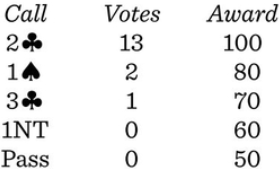
2♣ takes Cohen on a trip down memory lane. “This reminds me of how I once forgot that I was playing BROmAD (Bergen Raises Of a minor After Double) – whereby this bid showed an artificial diamond raise! Here, I hope it is natural.”
Colchamiro has trod that same street himself. “2♣, if natural. If 2♣shows a diamond fit, then put me down for 3♣ (weak). This is not a hand to start with ♠J x x x.”
Meckstroth: “2♣. I want to bid where I live.”
Boehm: “2♣, the meat of my hand. I can back in with spades later. 3♣ might work better if they have an eightcard fit.”
Sanborn, too: “2♣, nonforcing and just about right. I can compete with 2♠ if it gets back around to me. Again, this would not be forcing and would paint a picture of my shape and strength.”
2♣ by Meyers. “If I have the opportunity at my next turn, I will bid 3♣ (or 2♠).”
Weinstein says he’s bidding his longest suit first, too. “I plan on showing spades if they compete to 2♥. Because I expect my partner to raise spades with three-card support, I don’t like to bid a bad four-card suit immediately after they make a takeout double.”
Korbel agrees that 2♣ and then 2♠, if the auction allows, “gives partner an excellent picture of my hand.”
Rigal, 2♣: “Here, this club suit is way too good to ignore. I play this as nonforcing, so it is perfect. I may consider bidding spades later.”
Kennedy likes 2♣. “I’m not tempted to bid 1♠ with such a bad four-card suit.”
Ditto Lee: “It’s a bit of a stretch, but I’m not bidding spades, and passing is too meek for me with reasonable clubs and good shape.”
Falk, too. “This is not forcing, so later I can consider bidding 2♠ if that seems right. Meanwhile, 1♦ could be going for a number. If I were to bid 1♠ now – the call I would have made if East had passed – I would lose the club suit forever. But here, bidding clubs does not bar me from finding spades later.”
Two panelists, however, can’t let that major go unbid.
One, predictably, is Robinson. “1♠: the same bid I would have made if East had passed. I ignore takeout doubles when I have a four-card major.”
Hampson also bids 1♠. “Finding an eight-card spade fit is our best chance to out-compete the opposition in their likely heart fit. I will find myself uncomfortable opposite a 2♦ rebid, but it is not certain that clubs would have been a better trump suit.”
The Sutherlins ratchet the bidding all the way up to 3♣. “Shows a hand equivalent to a weak two in clubs and takes up some room on a deal that’s up for grabs. Bidding 1♠ would be better only when we have a 4–4 spade fit and trumps split 3–2.”
