

What’s your call?
| 4NT | ||||
| 5♣ | 5♦ | 5♥ | 5♠ | 5NT |
| 6♣ | 6♦ | 6♥ | 6♠ | 6NT |
| 7♣ | 7♦ | 7♥ | 7♠ | 7NT |
| Pass |
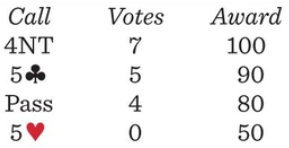
It’s difficult not to believe the opponents at this vulnerability, making bidding a more popular choice than defending 4♠ doubled.
Sanborn plays 4NT as a two-suited takeout. “It looks right to pass, but I always catch my partner with five of my minor when I do. The opponents are probably not kidding around and rate to have some distribution at these colors.”
Cohen frames his 4NT quite simply: “It’s too easy to believe that pass gets us minus 790.”
Rigal: “4NT, two-suited – partner picks his better minor and I correct diamonds to hearts. Yes, it could be right to pass the double, but my experience is that there are more IMPs around for removing these doubles when it is right than are lost for removing inappropriately.”
Lee, too. “Feels right to bid 4NT with no spade card and a smattering of shape and values.”
Weinstein’s 4NT: “I hope my competitors aren’t reading this. My opponents seem to always have their bids and then some at this vulnerability, especially when their suit is spades. Their 4♠ bid often leaves no choice but to double. But just to cover myself: To anyone reading this, I vow to pass the next time I pick up this hand.”
Korbel says, “Partner made a takeout double, and I have some values and some shape, so I will take it out. It’s important to bid 4NT rather than 5♣, as sometimes partner is stuck with a 2=4=5=2 or similar hand type.”
The Sutherlins agree that 4NT is the best path to 5♣ or 5♥. “Passing risks partner holding something like:
♠x ♥A 10 x x ♦ A x x ♣K J x x x,
which would probably result in the opponents being plus 790 or 990, when we could be down only one in 5♣.”
Several panelists chose 5♣ rather than portraying their hand as a twosuiter.
Robinson’s 5♣ rationale: “I was thinking about 4NT, but there’s a chance we might end up in a 4–3 heart fit. I think partner’s double is save-oriented as well as strength-showing.”
Colchamiro bids 5♣, too. “I’m torn between the fashionable 4NT, showing two places to play, and the honest 5♣. Both show some values, for with a bust, I’d pass and hope we’d beat them – at least that’s what my book says. Because they are at unfavorable, I’m counting on them to have 10 spades, so partner’s double should contain club support.”
5♣ by Hampson, who says “I want to play clubs unless partner has a strong desire to play elsewhere. So I will bid them. I will correct diamonds to hearts, though.”
Boehm. “5♣. Facing short spades and a likely double fit, I risk an expensive double-game swing by passing.”
Lawrence fearlessly passes, asserting, “I have some defense and no assurance that partner has a singleton spade.”
Falk issues a green card, too: “Double is not penalty (it should show ‘convertible values’); I’m supposed to bid only when I am fairly distributional. My hand is pretty flat, so I choose to defend. If I were inclined to bid, I’d try 4NT to be sure of landing in our best round-suit fit.”
Stack passes. “I don’t think we can make anything at the five level, and with one and a half quick tricks, the opponents should be going set. Let’s pass and take our plus score.”
