
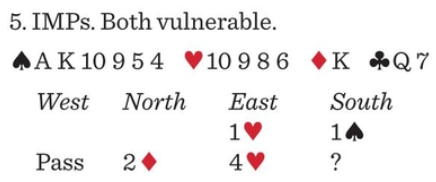
What’s your call?
| 4♠ | 4NT | |||
| 5♣ | 5♦ | 5♥ | 5♠ | 5NT |
| 6♣ | 6♦ | 6♥ | 6♠ | 6NT |
| 7♣ | 7♦ | 7♥ | 7♠ | 7NT |
| Pass | Dbl |
Seriously, is there no such thing as a peaceful, noncompetitive auction anymore?
Boehm is content to pass. “This looks like a flexible hand with extra values for both offense and defense, so why make a commitment? I’ll be charmed whether partner bids or doubles. If he passes and they go down, at least we get a plus score and may win IMPs if the other table bids with our cards and goes set.”
Cohen passes. “I don’t have enough extra offense or defense to take action in front of partner.”
Lee, too. “It’s possible we make 4♠, but it seems like a big position to bid it. I don’t think we have enough stuff to double, and if partner wants to back in over 4♥, I don’t want to discourage him.”
Sanborn: “Pass. Nothing else makes sense.”
Pass by Korbel. “I showed a little something by overcalling vulnerable in the first place. I have no reason to believe we should be continuing in this auction. Let partner decide what to do.”
Pass by Falk. “2♦ may have been forward-going, but so what? It just means partner has a quality diamond suit and no spade support. Meanwhile, East heard the auction and bid 4♥ vulnerable opposite a passing partner, so I would expect him to be 1=7=1=4 or something along those lines. The pointed suits are breaking atrociously for us, and I have maybe one defensive trick against 4♥. I can hope partner is 1=1=7=4, but I still cannot be sure of that or that partner’s diamonds won’t have several intermediate losers, making 5♦ too expensive. In the future, poor partner will be afraid to bid a new suit with less than 100 honors after I overcall, so the risk to partnership trust in doing anything is too great.”
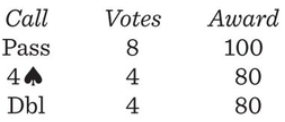
Four panelists double and four panelists bid 4♠.
Lawrence, one of the doublers, observes, “This hand comes with a lot of flaws for playing in spades.”
Colchamiro doubles. “Partner doesn’t have to have spades – for example,
♠x ♥x ♦ A Q x x x x x ♣A 10 x x.
My defensive potential is enormous. I expect between plus 200 and 800 with an outside shot at 1100 on a great day against a maybe-game our way where we know the suits are not breaking well.”
Stack: “Scary! Doubling with no real trump tricks! But partner has directed a lead and I am short in diamonds, so how can they possibly make it? I have rationalized like this many times in the past to my chagrin. While pass would not be forcing, it might encourage partner to bid diamonds again.”
And here’s Rigal with the red card: “If partner does not have spade length, we can hope some or most of our winners will stand up.”
Meyers chooses to bid 4♠. “Double is an option, but I don’t think it’s the most viable option.”
Robinson bids 4♠, too. “Partner’s 2♦ shows some values, so with luck, 4♠ will make.”
The Sutherlins are distressed. “Once again, our vulnerable opponent is forcing us to guess at the four level. East has voluntarily committed to make game. He probably has good clubs along with good hearts. We guess to save in 4♠.”
4♠ by Weinstein: “If East bid 2♥, I would have been a happy 2♠ bidder. If East had bid 3♥, I would have been a happy 3♠ bidder. But now I’m an unhappy 4♠ bidder.”
My, my, all this unhappiness, and yet we keep coming back to the table for more. Isn’t bridge a great game!
