
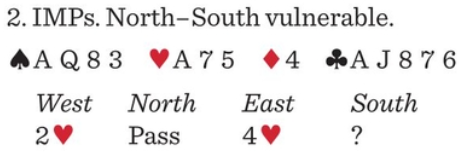
What’s your call?
| 4♠ | 4NT | |||
| 5♣ | 5♦ | 5♥ | 5♠ | 5NT |
| 6♣ | 6♦ | 6♥ | 6♠ | 6NT |
| 7♣ | 7♦ | 7♥ | 7♠ | 7NT |
| Pass | Dbl |
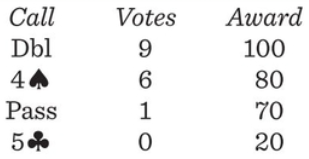
Hampson explains why double is the slight favorite. “I am taking a big risk that partner might bid diamonds with a totally unsuitable [Pun intended, right?] hand, but I have two other strains that could easily be our fit, and we will not find them if I pass.”
Rigal’s melodramatic double: “Yes, terrible, I know, and I’m prepared to accept minus 1100, but it is, after all, only IMPs. Total point scoring might be worse (he said optimistically). Passing seems feeble and bidding 4♠ even on paper – rather than real life – is just a tad too rich for me.”
Weinstein’s double is calmer, more matter-of-fact because he does the math. “Passing risks missing a game. Doubling risks going for a number if partner bids 5♦ . Because I expect to make game if he bids 4♠, 4NT or 5♣, I will chance the occasional disaster in 5♦ . When he bids 5♦ , he will almost always have at least six diamonds. So we might survive.”
Lee puts his money on double, too. “I’ll pay off to partner having long diamonds without four of a black suit.”
Meckstroth is a doubler. “With excellent offense and defense, it’s too risky to pass.”
The always accommodating Ms. Meyers: “Double, but I don’t mind pass. Double is not going to work out well if partner bids 5♦ .”
Robinson’s is a close-your-eyes-anddouble double. “Good partners bid 4♠, even with:
♠J x x x ♥x ♦ A Q J x x x x ♣x.”
Meanwhile, Falk’s double is flatout optimistic. “As they say, the worst does not necessarily have to happen. Partner might bid 4♠ or 4NT to give me a choice of minors. There’s just too big a chance we are missing a game for me to pass.”
Stack calls double scary, but he doubles anyway. “This is too much hand to pass. There is nothing that partner can do to embarrass this hand except possibly bid 5♦ .”
You know what’s chilling, Don? Overcalling 4♠ with that suit at the four level!
Sanborn: “4♠. Scary, right? I am imagining a heart fit and running diamonds on my right, not a balanced power hand. Obviously double is out of the question, so it is between passing and bidding. I will pull to 5♣ if there’s a mighty double. Or even a very quiet, dangerous one.”
The Sutherlins also prefer 4♠. “Too much to pass. Not good enough to bid 5♣. Double might produce 5♦ from partner. We’ll take a chance with 4♠, which is our most likely game.”
Colchamiro, too: “OK, you got me … but have mercy on my soul.”
Boehm chooses 4♠. “Even a 4–3 fit may survive, taking ruffs in the short hand. This could well be our last chance to introduce spades. Partner is too short in hearts to pass my double, and his 5♦ takeout is too ghastly to contemplate.”
Korbel: “Any of pass, double or 4♠ is possible here. The ‘book bid’ is definitely to pass, but our hand is powerful enough that we expect to defeat 4♥, and we have to worry about making game opposite even a weak hand from partner, for example:
♠K x x x x ♥x ♦ x x x x ♣x x x.
The thought of partner bidding 5♦ in response to my double is enough to make me retch. Anything could be right, but this time I’ll test the waters with 4♠, Joe-Grue style.”
Lawrence, 4♠, kvetching (as usual). “Getting 150 against 4♥ isn’t going to do it. If partner has four spades, both double and 4♠ will work. But if I double and hear 5♦ , I’m just screwed. Given partner has one or no hearts, he will certainly be pulling my double. No way to get 500. Really, there’s no perfection here. Just luck.”
All alone in the passing lane is Cohen. “Painful. But not as painful as getting doubled in 4♠ or having partner remove a double to 5♦ .”
