
What’s your call?
| 1♣ | 1♦ | 1♥ | 1♠ | 1NT |
| 2♣ | 2♦ | 2♥ | 2♠ | 2NT |
| 3♣ | 3♦ | 3♥ | 3♠ | 3NT |
| 4♣ | 4♦ | 4♥ | 4♠ | 4NT |
| 5♣ | 5♦ | 5♥ | 5♠ | 5NT |
| 6♣ | 6♦ | 6♥ | 6♠ | 6NT |
| 7♣ | 7♦ | 7♥ | 7♠ | 7NT |
| Pass |
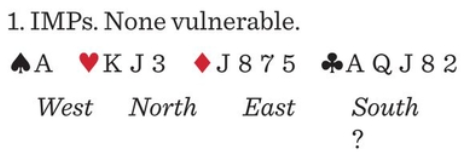
Before choosing an opening bid, plan your rebid; it’s a lesson drilled into bridge students from day two. You look at this hand, assign a 1♠ response to partner if you open 1♣ and now what?
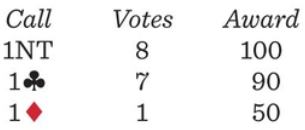
Half of the panelists solve the bid-and-rebid problem all at once by opening 1NT. You’re right: The dayone lesson was never open 1NT with a singleton.
Here’s Sanborn on behalf of the 1NT bidders: “An opening bid of 1♣ presents problems later in the auction. This hand is not good enough to reverse or rebid 2NT over 1♠, and is poorly placed even over a 1♥ response. And opening 1♦ just feels wrong, but is probably my second choice. I go with the least worst lie.”
“If you’re looking for 1NT,” Lawrence says, “I can sympathize. Perhaps even to the point of doing it. If partner transfers to spades, I oblige and hate it. The alternative opening is 1♣ (not 1♦ ), and then hating my rebid.”
Falk chooses 1NT. “This is sooooo not my style, but what will I rebid over either a 1♥ or 1♠ response if I open 1♣? A reverse on such a moth-eaten hand is worse, so I’m temporarily sliding the ♣2 over to my spades in case this hand becomes dummy and I have to explain myself to partner. By the way, if partner bids Smolen and shows five spades and four hearts, I’ll try 4♥ rather than 3NT. If North transfers me to spades, I’ll take my medicine.”
Meyers: “I don’t love anything on this hand. The big downside to 1NT is partner transferring to 2♠ or 4♠ with inadequate spades.”
1NT by Boehm. “Preemptive, eases our rebids and complicates their defense. Despite the spade risk, I predict this will become ‘standard’ by the end of the decade.”
Korbel’s 1NT: “Yes, it’s sick, I know. But I can’t bring myself to reverse into that diamond suit on such a minimal hand or open 1♦ and rebid 2♣. I know bad things can happen opening this hand type 1NT, but it’s definitely the direction in which the game is going.”
Rigal: “1NT. Yes, a 16-high-cardpoint hand with a singleton spade honor is about as bad as it gets. In my preferred methods, holding three spades and a singleton heart, I might open 1♣ and rebid 1♠, but 1=3=4=5 is much harder. Suggestion: Take any panelists who suggest 1♦ and ‘lightly kill’ them (to quote Monty Python). We’ll all be better off for it.”
Of the 50% of the panelists who can’t bring themselves to open 1NT, all but one choose 1♣ as their initial foray.
The Sutherlins call this a problem of strength versus strain. “You can open 1NT and describe the strength correctly. Or open 1♣ and probably be forced to make an under-strength reverse of 2♦ and have a better chance finding the right strain. Our preference is to emphasize strain.”
Cohen calls this an image problem. “I can’t allow my students to see me opening 1NT in print with a singleton. Yes, I am aware of the looming rebid problems.”
Robinson looks beyond his rebid to consider the defense. “If partner responds one of a major, I have to find an awkward rebid. Sometimes, however, it’s a competitive hand and it’s good to have opened 1♣.”
1♣ by Meckstroth, not one to mince words: “Notrump openers with stiff aces are big losers.”
Hampson agrees: “I am strong enough to bid my suits in order of length, and 1NT with a singleton ace has proven to be a loser.”
Stack, too, prefers 1♣. “There is no reason to open an off-shape 1NT or be afraid to reverse into the weak diamond suit. If partner bids 1♥, then this is a pretty good 2♦ reverse bid. If partner bids 1♠, this may not be such a great 2♦ reverse, and a 1NT or 2♣ rebid are possibilities.”
Lee, 1♣. “It’s close between this and 1NT, but I can barely stomach a reverse with this hand and I don’t like to open 1NT with a singleton ace. I don’t think 1♦ is in the running.”
Not so fast, my friend …
1♦ by the lightly killed Colchamiro. “Normally I detest opening 1♦ with four (weak) diamonds and five clubs. But here I have a 2NT out if our auction goes 1♦ –1♠; 2♣–2♦ . Besides, any other approach is repugnant, including 1♣–1♠–2♣.”
